

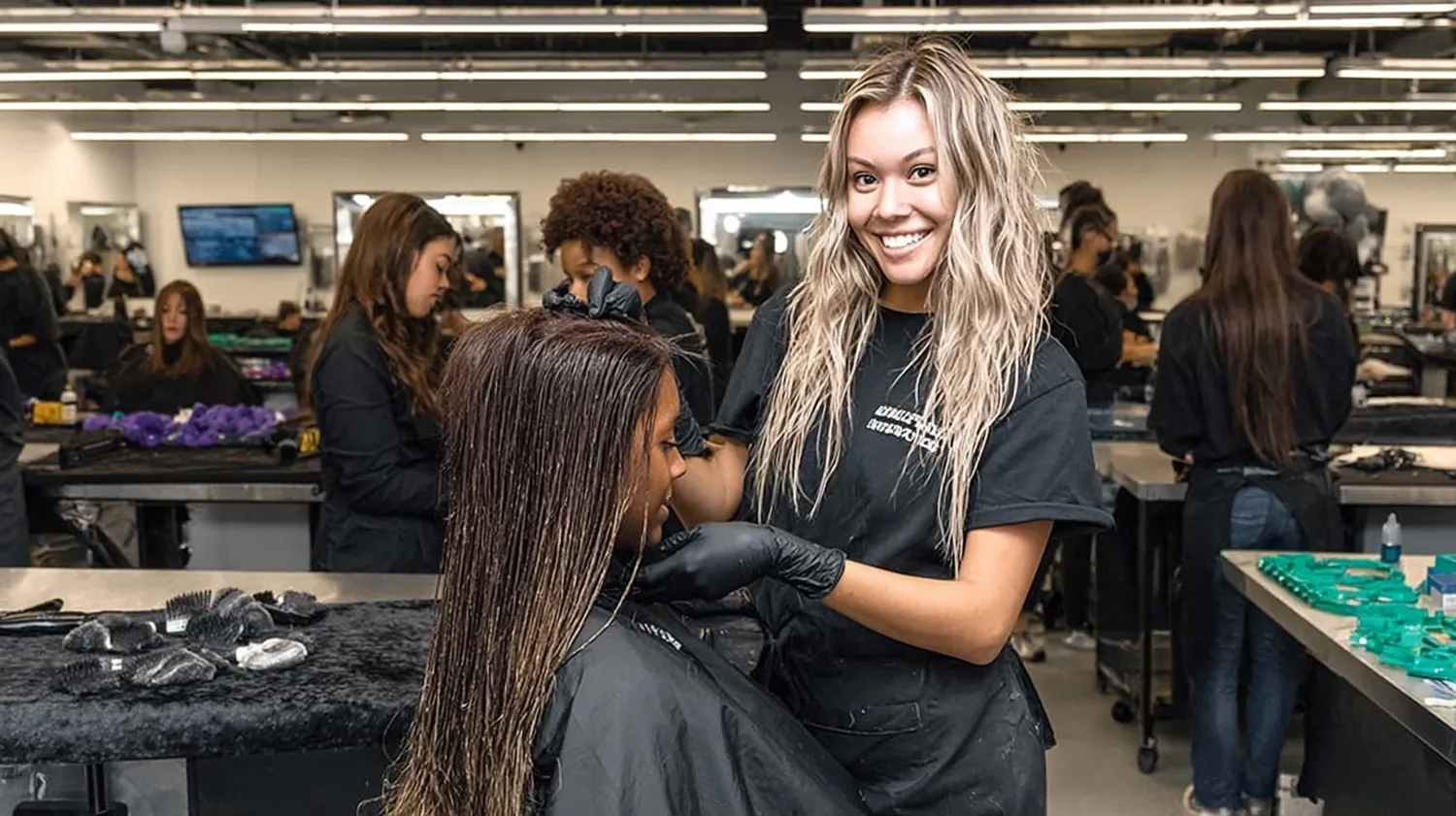
The global beauty and personal care market generated roughly $677 billion in revenue in 2025, according to Statista. In the United States alone, it's a $105 billion industry. Scroll through career-advice forums and you'll find people pointing to numbers like these as proof that cosmetology is a smart bet—a fast track into a booming field that doesn't require a four-year degree.
That framing isn't wrong, exactly. But it leaves out quite a lot.
The Bureau of Labor Statistics reports that the median hourly wage for hairdressers, hairstylists, and cosmetologists was $16.95 in May 2024—roughly $35,250 a year, well below the $49,500 median across all occupations. The BLS projects 5 percent employment growth for the field from 2024 to 2034, which is faster than average but nowhere near the 19 percent figure that still circulates on some beauty-school marketing pages, a number drawn from an earlier projection cycle and a different occupational grouping. So is cosmetology school worth the investment? The honest answer depends on what you specialize in, where you work, how you structure your career, and whether you understand from the start that the first few years are about building a foundation, not earning a living wage. This guide lays out the real numbers so you can make an informed decision rather than a hopeful one.
• • •
What Cosmetology School Actually Costs
The sticker price for cosmetology school in the United States typically falls between $15,000 and $20,000 for tuition alone. Data compiled by Milady, the leading cosmetology textbook publisher, puts the national average at around $16,251 when you factor in tuition, student kits, and licensing fees. That is dramatically less than the roughly $64,000 average cost of a four-year college degree—one of the industry's strongest selling points, and a legitimate one.
But the headline number masks real variation. Brand-name schools like Paul Mitchell and Aveda Institutes, particularly those in major metros, can charge $18,000 to $22,000 or more. Community colleges with cosmetology programs sometimes come in under $10,000 for in-state students. On top of tuition, students should budget $1,200 to $2,500 for a professional kit (scissors, brushes, mannequin heads, styling products), another $500 to $1,000 for textbooks and supplies, and $50 to $300 for state board licensing exam fees. A realistic all-in cost at a mid-range private school sits between $17,000 and $22,000.
Financial aid does exist. Schools approved for Title IV federal aid allow students to apply through FAFSA, and Pell Grants can cover up to $7,395 per year for eligible students without requiring repayment. Federal student loans are also available. But a 2021 study from the Institute for Justice found that cosmetology students borrowed an average of about $7,300 in federal loans—$600 more than the average across all students—and that cosmetology programs collectively received over $1 billion in federal loans and grants in the 2019–2020 academic year.
That same study surfaced a troubling finding about completion rates. On average, fewer than one-third of cosmetology students finished their programs on schedule. In some years, between 15 and 31 percent of schools graduated zero students on time. Delays mean additional months without professional income and, for students who borrowed, more debt pressure before they ever pick up their first paying client.
• • •
Hours, Licensing, and the Regulatory Patchwork
Every state requires cosmetologists to hold a license. The path runs through a state-approved program plus a two-part exam—written theory and a practical skills demonstration. So far, straightforward. The complication is training hours.
Most states require between 1,000 and 2,100 hours of cosmetology education, with a national average of approximately 1,500 hours. At a full-time pace, that translates to 9 to 18 months of training. The range is wide enough to matter financially: New York requires 1,000 hours, California and Texas require 1,600, and Oregon demands 2,300—one of the highest in the country. Some states allow apprenticeship as an alternative, though apprenticeships generally require double the school hours and take correspondingly longer to complete.
A handful of states have recently reduced their requirements, a trend driven partly by advocacy from organizations like the Institute for Justice, which has pointed out that cosmetologists must, on average, complete 11 times as many training hours as entry-level emergency medical technicians. That disparity has become harder to defend, and more reform may follow.
Licensing reciprocity is the other wrinkle prospective students should know about. If you earn your license in one state and later move, transferring it isn't always simple. Some states offer full reciprocity; others require additional hours, a jurisprudence exam, or proof of one to three years of practice. It won't derail a career, but it's an administrative reality worth planning for—especially if you might relocate.
• • •
The Salary Reality
This is where the conversation gets uncomfortable.
The BLS median annual wage of $35,250 for hairdressers, hairstylists, and cosmetologists places the profession well below the national median for all workers. The lowest 10 percent earned less than $11.82 per hour; the highest 10 percent earned more than $33.76. That's a wide spread, and it signals something important: the income ceiling is meaningful, but the floor is low, and many professionals stay closer to the floor than the ceiling.
Several factors explain the modest median. Part-time work is common—many cosmetologists work fewer than 40 hours a week, whether by choice or because they're still building a roster. The BLS data also exclude self-employed workers, and a substantial share of cosmetologists are booth renters, freelancers, and solo operators. Tips, while theoretically included in BLS figures, are widely understood to be underreported. All of this means the median likely understates full-time earnings for established professionals. But it also means the profession's financial rewards are highly uneven.
The first two to three years are typically the hardest financially. New graduates are building a client base from scratch, often on commission-plus-tips arrangements. A common salon structure pays 40 to 60 percent of service revenue, with tips on top. Some salons offer an hourly guarantee; many don't. A first-year cosmetologist in a mid-range salon might take home $20,000 to $28,000 before tips. After year three, as client loyalty builds and rebooking rates climb, earnings typically accelerate—but prospective students need to plan for that lean launch period, not be blindsided by it.
Location matters enormously. Cosmetologists in Seattle, Boston, Washington D.C., and Los Angeles tend to earn more. At the state level, Washington, Maine, Illinois, Minnesota, and New Jersey rank among the highest-paying. The BLS also notes that the highest-paying industry setting for cosmetologists is the motion picture and video industry—though those positions are rare and intensely competitive.
• • •
Beyond the Salon Chair
One of the most common mistakes in evaluating cosmetology as a career is imagining only one version of it: standing behind a chair cutting hair for 30 years. In practice, a cosmetology license opens doors to a much wider range of paths, and the professionals who earn the most tend to be the ones who specialize, diversify, or build businesses.
Esthetics and skincare is the fastest-growing segment of the beauty services workforce. The BLS projects 7 percent growth for skincare specialists through 2034, driven by expanding consumer demand for facials, chemical peels, microdermabrasion, and anti-aging treatments. The median hourly wage was $19.98 in May 2024—meaningfully higher than the cosmetologist median. Estheticians who add advanced certifications in laser treatments, permanent makeup, or medical aesthetics can push earnings considerably higher. Some solo practitioners with full schedules and loyal followings report annual incomes above $100,000, though those are outliers.
Nail technology has a lower barrier to entry—most states require only 200 to 750 hours of training—with a BLS median wage of $16.66 per hour across about 148,000 workers. Makeup artistry spans everything from freelance bridal work to theatrical and film production. The BLS tracks theatrical makeup artists separately and reports a median of $24.17 per hour, but the field is tiny: roughly 3,300 jobs nationwide, concentrated in Los Angeles and New York.
Salon ownership represents the highest earning potential on the traditional track. Various salary sources suggest owners average roughly $75,000 to $90,000, with significant variation by location and scale. But salon ownership is entrepreneurship, full stop. It carries all the risks of running a small business: overhead, payroll, insurance, marketing, and the relentless pressure of maintaining cash flow.
Then there are the less obvious paths. Beauty education—teaching at licensed cosmetology schools—offers stability and typically requires an active license plus 500 to 1,000 additional instructor training hours. Product companies hire cosmetologists as brand educators and sales representatives, roles that often pay $50,000 to $75,000 with benefits and travel. And the social media and content creation pathway, which barely existed a decade ago, now represents a legitimate income stream: beauty influencers with large followings earn six or even seven figures from sponsorships and brand deals, though the vast majority earn far less. What a cosmetology background provides in that arena is something purely self-taught creators lack—credibility and deep technical knowledge.
• • •
Making the Math Work
Whether cosmetology school is "worth it" ultimately reduces to a return-on-investment calculation, and the variables are more personal than people sometimes acknowledge.
A $16,000 investment in a 12-month program that leads to a career earning $35,000 to $45,000 within a few years is a reasonable deal—particularly compared to a four-year degree in a field with uncertain job prospects. But $20,000 financed entirely with student loans, followed by two years of earning $22,000 while building a client base, is a much harder proposition, especially for students from lower-income backgrounds who can't afford a slow start.
The students most likely to find the investment worthwhile tend to share certain characteristics. They're genuinely passionate about the work itself, not just the idea of working in beauty. They think about specialization, client acquisition, and income diversification before they graduate—approaching the career with a business mindset from day one. They choose schools carefully, looking at on-time graduation rates and job placement data, not just tuition. And they have realistic expectations about the earning timeline.
Prospective students should also think hard about which track fits their goals. If skincare fascinates you, an esthetics program—shorter and cheaper in most states—may offer a faster return. If the entrepreneurial side appeals, a cosmetology license is a strong foundation, but you'll need business education layered on top. If you want stable income with benefits, a larger salon chain or a transition into brand education may beat booth rental long-term.
Watch for red flags when evaluating schools. Be skeptical of programs that trumpet industry growth statistics without contextualizing salary data. Ask for on-time completion rates, not just overall graduation numbers. Check accreditation and FAFSA eligibility. And take marketing claims about average earnings with a large grain of salt—schools have every incentive to highlight their most successful graduates, not their median outcomes.
• • •
What to Watch For
The beauty services industry is changing in ways that will reshape cosmetology over the next decade. Medical aesthetics—Botox, fillers, laser treatments—is creating higher-paying roles for estheticians willing to pursue advanced training. The beauty tech market, valued at $66 billion in 2024 and projected to nearly triple by 2030, is introducing AI-powered skin analysis and virtual consultations that will change how professionals interact with clients. Social commerce continues to blur the line between beauty professional and content creator.
On the regulatory side, several states have cut licensing hour requirements in recent years, and the push for reform continues. If that trend accelerates, the cost and time investment for entering the field could drop meaningfully.
The bottom line: cosmetology can be a financially viable and deeply satisfying career. But it is not the easy on-ramp that some marketing materials suggest. It requires genuine skill, business savvy, patience through the early lean years, and a clear-eyed understanding of what the numbers actually say. For the right person—someone with passion for the craft, a plan for growth, and realistic expectations—it remains one of the more accessible and flexible career paths available. For everyone else, the numbers deserve a harder look before signing an enrollment agreement.
Sources
- U.S. Bureau of Labor Statistics. "Occupational Outlook Handbook: Barbers, Hairstylists, and Cosmetologists, 2024–2034."
- U.S. Bureau of Labor Statistics. "Occupational Employment and Wage Statistics, May 2024 National Data."
- U.S. Bureau of Labor Statistics. "Occupational Outlook Handbook: Skincare Specialists, 2024–2034."
- Milady / Cengage. "How Much Is Cosmetology School in 2025?"
- Institute for Justice. "Beauty School Debt and Drop-Outs." 2021.
- Statista. "Beauty & Personal Care Market Worldwide." 2025.
- Grand View Research. "Beauty Tech Market Size and Share." 2024–2030.
- The Century Foundation. "Study on Cosmetology School Graduate Outcomes." 2022.
- NCES, IPEDS. "Cosmetology Program Data."
- BeautySchoolsDirectory.com. "Cosmetology Salary Data by State." 2024–2025.