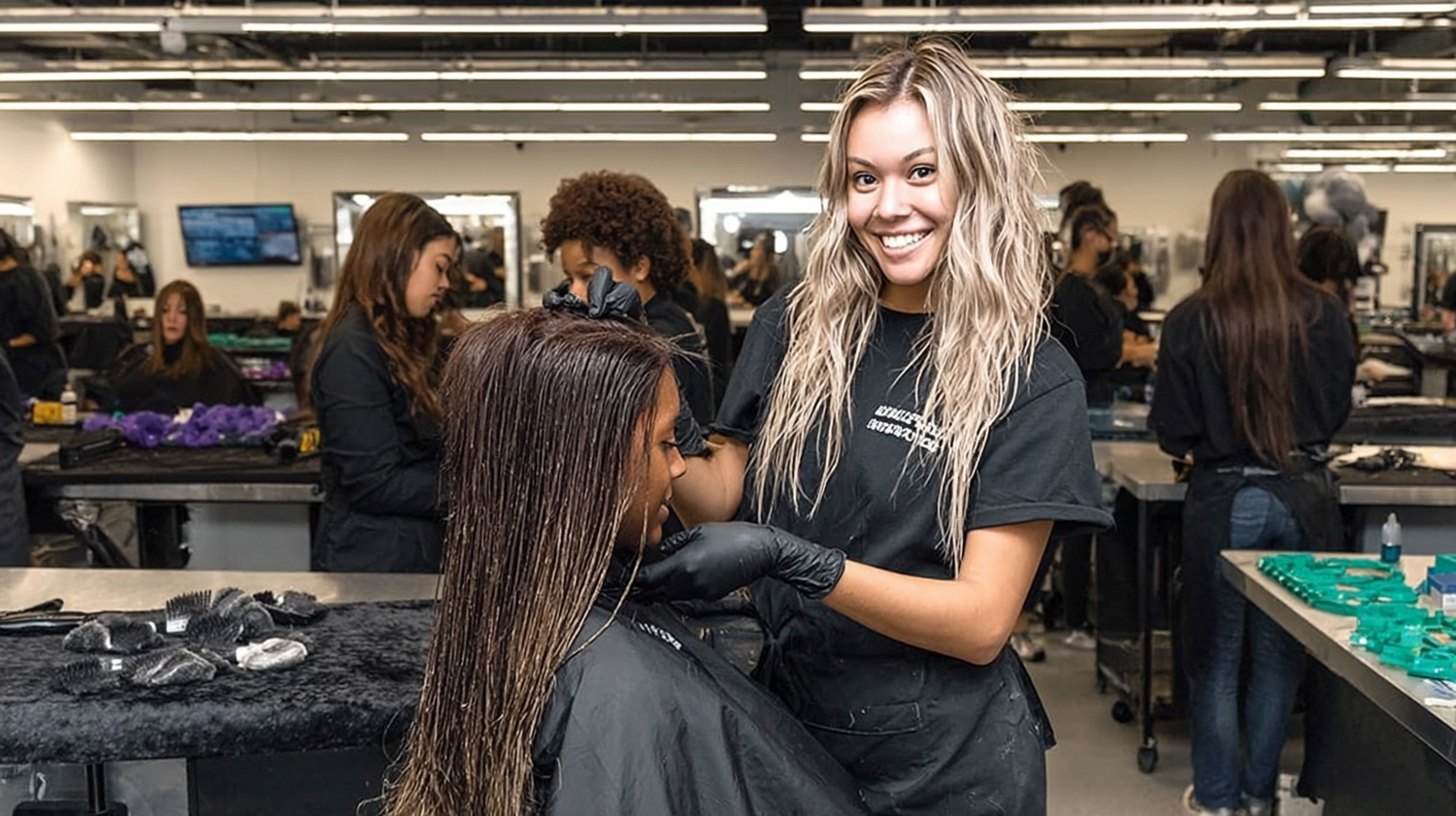


The beauty industry has a branding problem — not in the consumer-facing sense, where everything is extremely well-branded, but in the career sense. Ask most people what a cosmetologist earns and they will guess low, probably somewhere around minimum wage. Ask them whether a beauty career can yield six figures and you will mostly get polite skepticism. The Bureau of Labor Statistics seems to confirm this suspicion: the median hourly wage for hairdressers, hairstylists, and cosmetologists was $16.95 in May 2024. Do the math on a 40-hour week and you land around $35,256 a year, which does not sound like anyone's path to financial independence.
But that number is profoundly misleading, and understanding why reveals something important about how the modern beauty industry actually works. The BLS figure excludes the self-employed, a huge chunk of the profession. It often reflects part-time schedules in an industry where part-time work is common by choice. And it rolls together brand-new licensees earning their first dollars behind a chair with veteran stylists who have spent a decade building clientele and raising prices. The real earning picture is far more interesting, more varied, and more optimistic than the headline number suggests.
This matters right now because the beauty workforce is booming. The personal care services industry is up roughly 19% from pre-pandemic levels, according to BLS data, recovering from COVID-era shutdowns and then some. Employment for barbers, hairstylists, and cosmetologists is projected to grow 5% through 2034, faster than average, with about 84,200 openings expected annually. Skincare specialists are growing even faster, at 7%. The restaurant industry gets credit for being America's second-largest private-sector employer, but the beauty industry — with more than 1.2 million cosmetologists, estheticians, and nail technicians working in independent salons and spas in the U.S. alone — is quietly one of the most accessible paths into entrepreneurship the economy offers.
So here is what the path actually looks like: how the money works, what determines whether you earn $30,000 or $130,000, and how the business model is being reshaped by everything from suite rentals to social media.
* * *
The real earning math
To understand beauty industry compensation, you need to understand that this is not a salaried profession. It is a profession of micro-businesses, even when the people running them don't think of themselves that way. How much a beauty professional earns depends almost entirely on three variables: how many clients they see, what they charge per service, and what percentage of each dollar they actually keep.
The keeping part is where the business model comes in. There are three primary structures, and each creates a radically different economic reality.
In a commission-based salon, the stylist is an employee. The salon provides the space, products, equipment, and often some level of client flow. In return, the salon keeps a percentage of every service — typically 40% to 60%. A stylist earning a 50% commission on a $100 color service takes home $50 from that appointment. On top of this, commission stylists usually keep their tips (which industry sources estimate add 15% to 25% to base earnings) and may earn a small retail commission of 10% to 15% on product sales. The trade-off is stability: the salon handles marketing, scheduling, supplies, payroll taxes, and often benefits. For new stylists without a client base, commission is the rational starting point.
In booth rental, the stylist pays a fixed weekly or monthly fee — typically $200 to $800 per week, varying enormously by market — to rent a chair in an existing salon. They keep 100% of their service earnings and tips. They also pay for their own products, supplies, insurance, marketing, and taxes. This is functionally a small business, even if the stylist doesn't always frame it that way. Industry analysts at Thriving Stylist estimate that even lean booth renters typically spend about 49% of gross revenue on overhead, leaving roughly 51% as pre-tax income. After self-employment taxes, a booth renter grossing $100,000 might take home around $34,000 to $40,000 — before income tax.
That sounds grim until you consider the upside. A commission stylist grossing $100,000 in services at a 50% split takes home $50,000, but has limited ability to raise prices, set schedules, or choose products. A booth renter grossing $150,000 might net more after expenses than the commission stylist, and has complete control over their business. The higher the gross revenue, the better booth rental economics become, because the fixed costs (rent, insurance, software) don't scale proportionally with income.
The third model is salon ownership, which is a different animal entirely. According to data compiled by Glassdoor, salon owners typically earn between $60,000 and over $200,000 annually, but the range is extreme. The average salon generates about $245,000 in annual revenue with profit margins around 8.2%. Owning a salon means managing employees, lease obligations, inventory, and all the headaches of running a physical retail business. Many beauty professionals treat it as a long-term goal, not a starting point.
* * *
Getting to six figures: what the trajectory looks like
The six-figure cosmetologist is not a myth, but it is not the median experience either. Getting there requires some combination of high service prices, a full book of loyal clients, and smart business structure. The math is surprisingly straightforward once you lay it out.
Consider a stylist seeing 25 clients per week at an average service price of $120. That is five clients a day across a five-day week, or six a day on a four-day week. At $120 per service, that produces $3,000 in weekly revenue, or roughly $150,000 annually assuming two weeks of vacation. Add 20% in tips and you're generating $180,000 in gross revenue. At a 45% commission rate, that stylist takes home $81,000 in commission plus $30,000 in tips — roughly $111,000 before taxes.
The catch is that reaching 25 clients per week with a $120 average service price takes time. New stylists typically start with lower prices and smaller client books. Industry data suggests that building a solid, recurring client base takes two to three years of consistent work. Client retention in salons averages about 45% from first to second appointment, meaning that more than half of new clients never come back. The stylists who reach high income build it cumulatively: each retained client is effectively a permanent raise, and a loyal client who visits every six weeks for years represents thousands of dollars in lifetime value.
Specialization accelerates this dramatically. Color correction specialists average around $62,000 nationally but can charge $300 to $500 per session in major markets. Hair extension specialists command premium prices. Balayage, keratin treatments, and textured hair services all push average ticket prices well above a basic cut. The BLS notes that demand for hair coloring, straightening, and other advanced treatments is a major driver of employment growth — and it is also a major driver of individual earning growth, because these services take longer, cost more, and require expertise that not every stylist offers.
* * *
The cross-training advantage
One of the most significant shifts in the beauty industry over the past decade is the blurring of specialty lines. A cosmetology license in most states already covers hair, skin, and nails, but historically most professionals chose one lane. Increasingly, the professionals earning the most are the ones who offer services across multiple categories.
The numbers support this. Skincare specialists earned a median hourly wage of $19.98 in May 2024, higher than the $16.95 median for hairstylists. Skincare employment is projected to grow 7% through 2034 — more than double the average for all occupations. Manicurists and pedicurists are also growing at 7%, with about 24,800 annual openings. The highest-paid cosmetologists in BLS data, those in the motion picture and video industries, earned a mean wage of nearly $98,000 because they combine hair, skin, and makeup skills.
For a beauty professional building a career in 2026, the strategic logic of cross-training is clear. A stylist who can also offer facials, lash extensions, or brow services captures more revenue per client visit and differentiates from competitors. A nail technician who adds skincare creates appointment combos that increase average ticket size. In the suite-rental model, where professionals rent a private room rather than just a chair, offering multiple services is essential to filling the schedule and justifying the higher rent.
The investment in additional training is typically modest relative to the return. Esthetician programs range from 260 to 1,000 hours depending on the state, and specialized certifications in lash extensions, microblading, or advanced skincare treatments can be completed in days or weeks. Each additional credential is both a new revenue stream and a client retention tool.
* * *
How social media changed the business model
If there is a single force that has most dramatically reshaped beauty careers in the past five years, it is Instagram and TikTok. These platforms did something that used to be impossible: they gave individual beauty professionals the ability to build a brand and attract clients without being in a high-traffic salon location or relying on walk-in traffic.
The impact is hard to overstate. Social media now drives the majority of product discovery in the beauty space — industry research suggests 87% of beauty product discovery happens on social platforms. For individual practitioners, a strong Instagram or TikTok presence functions as a 24/7 portfolio, referral engine, and marketing channel. Before-and-after transformation photos, time-lapse videos of color processes, and educational skincare content consistently rank among the most engaging content types on both platforms.
This has created a genuinely new career dynamic. A stylist with 10,000 engaged local followers on Instagram can maintain a full book without paying for advertising, without depending on salon walk-in traffic, and without networking in the traditional sense. They can open a solo suite in a less expensive location — no foot traffic required — and fill it entirely through their social presence. Some beauty professionals have built large enough followings to earn additional income through brand partnerships, sponsored content, product lines, and educational workshops. A handful have become genuinely famous, but the more widespread impact is on thousands of mid-tier professionals who simply use social media to keep their chairs full.
The flip side is real, too. Social media rewards consistency, and producing content on top of a full service schedule is genuine work. Trends cycle fast. Algorithm changes can reduce visibility overnight. And there is a risk of conflating social media success with business success — a viral video does not automatically translate to booked appointments if the audience is national and the service is local. The professionals who benefit most treat social media as a marketing channel, not an end in itself: targeted to their local market, consistent in posting schedule, and focused on showcasing the quality of their actual work rather than chasing trends.
* * *
What the path forward looks like
The typical beauty career arc has a shape, and understanding it matters for anyone deciding whether to pursue cosmetology school. Year one is an investment period: completing a state-approved program (most cosmetology programs require 1,000 to 1,600 hours and cost between $6,000 and $20,000 at community colleges or trade schools, considerably more at private institutions), passing the state licensing exam, and getting that first position, usually on commission at an established salon.
Years two through four are the building period. The priority is accumulating clients and skills — taking continuing education, learning advanced techniques, building a portfolio, and starting to develop a social media presence. Income during this phase is typically in the $25,000 to $45,000 range for full-time commission stylists, though tips and retail commissions push the effective number higher. This is also when many professionals pursue additional certifications in skincare, lash services, or other specialties.
Around year three to five, professionals with a strong client base face the first major career fork: stay on commission with its stability and team environment, or move to booth rental or suite rental for higher earning potential and independence. The conventional wisdom in the industry — and it is largely correct — is that this transition should not happen too early. A booth renter without enough clients to cover the fixed costs of rent and supplies is in a financially precarious position.
By years five through ten, the highest earners have typically settled into a model that fits their goals. Some are high-volume stylists seeing 30 or more clients a week at moderate prices. Some are specialists charging premium rates for complex services and seeing fewer clients. Some have transitioned into salon ownership, education, or brand consulting. The BLS projects chef and head cook employment to grow 7% through 2034, but the broader personal care sector offers something the restaurant industry largely does not: a well-established path from employee to independent contractor to business owner, with relatively low capital requirements at each stage.
The industry is projected to add nearly 90,000 new positions annually across all beauty occupations through the end of the decade. The restaurant and foodservice industry is America's second-largest private employer, but beauty's roughly 1.4 million salons and barbershops represent one of the densest networks of small businesses in the country. The $63 billion in annual salon and barbershop revenue nationwide is spread across hundreds of thousands of individual entrepreneurs, many of them women and people of color who found in beauty a path to ownership that other industries made difficult.
The honest picture is this: beauty is not an easy career. It is physically demanding, often requiring stylists to stand eight or more hours a day. It involves chemical exposure that requires real safety precautions. The early years pay modestly, and there is no guaranteed upward trajectory — building a clientele is a skill in itself, and not everyone succeeds at it. The median wage data is not lying, exactly. It is just describing the middle of a distribution that stretches from part-time workers earning near minimum wage to independent professionals clearing six figures.
What has changed is the ceiling, and the tools available to reach it. A cosmetologist in 2006 was largely dependent on the salon's location, reputation, and marketing to attract clients. A cosmetologist in 2026 can build a personal brand on Instagram, attract clients independently, offer a broader range of services through targeted continuing education, choose from a wider variety of business structures (commission, booth rental, suite rental, mobile services), and leverage booking software and CRM tools that once required an entire office staff to manage.
None of this happens automatically. The gap between the $35,000 median and the six-figure earner is not talent alone — it is business acumen. Pricing strategy, client retention, marketing, financial management, and the discipline to treat a creative profession as an actual business. Cosmetology programs that teach these skills alongside technique are, increasingly, the ones producing graduates who thrive. And for parents and prospective students evaluating career training options, that is the question worth asking: not just what skills will you learn, but whether the program prepares you to build a business around them.
Sources
- U.S. Bureau of Labor Statistics. "Barbers, Hairstylists, and Cosmetologists: Occupational Outlook Handbook." 2024.
- U.S. Bureau of Labor Statistics. "Skincare Specialists: Occupational Outlook Handbook." 2024.
- U.S. Bureau of Labor Statistics. "Manicurists and Pedicurists: Occupational Outlook Handbook." 2024.
- U.S. Bureau of Labor Statistics. "Recovering from the Pandemic: A Bright Outlook for the Personal Care Service Industry." Beyond the Numbers, Vol. 11.
- U.S. Bureau of Labor Statistics. "Occupational Employment and Wage Statistics: Hairdressers, Hairstylists, and Cosmetologists." May 2024.
- IBISWorld. "Hair & Nail Salons in the US." 2023. Cited in industry statistics compilations.
- Thriving Stylist. "Commission vs. Booth Rental: Where's the Money?" and "What It Really Costs to Be a Booth Renter or Salon Owner." 2024.
- JD Academy. "Making $100K as a Stylist is Easier Than You Think." 2022.
- Spectrum News 1. "Enrollment at Culinary Schools Is Higher Than Ever Despite a Struggling Industry." October 2025. (Re: beauty/personal care industry employment trends.)
- Project Aeon. "10 Crucial Beauty Industry Statistics for 2025." November 2025.
- Glassdoor. "Salon Owner Salary Data." 2024–2025. Via industry compilations.
- Boulevard. "Client Retention Data for Salons." Cited in beauty industry statistics roundups, 2024.
- Silvie Hair Studio. "How Much Do Professional Hair Stylists Make?" June 2025.
- NaturalHealers.com. "Cosmetologist Salary and Job Outlook Guide." June 2025.
- Associated Barber College. "Cosmetology and Social Media: How Beauty Trends Are Shaping the Industry in 2025." February 2025.