

Here is a fact that catches most families off guard: in some states, becoming a licensed cosmetologist requires more training hours than becoming a licensed emergency medical technician. An aspiring stylist in Iowa or Oregon will complete around 2,100 hours of supervised instruction before sitting for a licensing exam. A paramedic in many states needs roughly 1,200. The comparison is imperfect, of course — these are different professions with different risks — but it illustrates something important about the world your child is about to enter. Cosmetology is one of the most heavily regulated entry-level professions in America, and the rules vary wildly depending on which side of a state line you happen to live on.
If your teenager or young adult is thinking about beauty school, you are probably already navigating a thicket of questions. How long will this take? How much will it cost? Will the license transfer if we move? These are not small concerns. A cosmetology education can represent a year or more of full-time study and anywhere from $5,000 to $20,000 in tuition, and the consequences of choosing the wrong school — one that is not properly approved, or one in a state whose hours will not transfer — can be genuinely painful. The licensing landscape is confusing by design, a patchwork of fifty different regulatory frameworks that have evolved over decades without much coordination. But it is navigable. And understanding the basics before your family writes the first tuition check can save an enormous amount of time, money, and frustration.
* * *
The single most important number in cosmetology licensing is the training-hour requirement, and it is the place where state-to-state variation is most dramatic. At the low end, New York requires just 1,000 hours of cosmetology instruction. California recently joined this tier after passing Senate Bill 803 in 2022, cutting its requirement from 1,600 hours to 1,000 and eliminating the practical exam entirely — a move that reduced both the time and cost of entry into the profession. Virginia followed suit in 2024, dropping from 1,500 to 1,000 hours. At the other end of the spectrum, Oregon and Iowa still require 2,100 hours, and a handful of states sit at 1,800 or above.
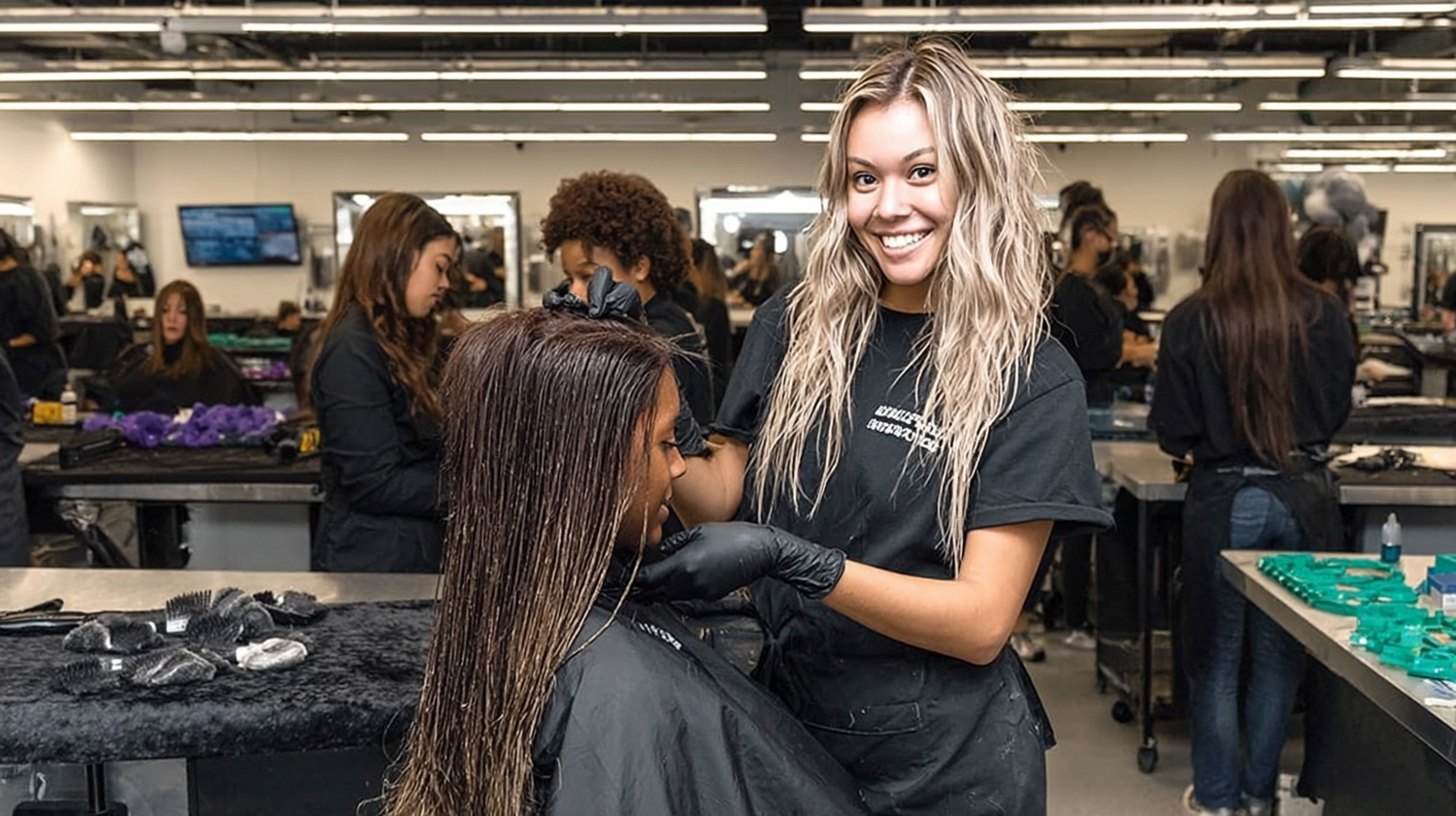
The national average hovers around 1,500 hours, which translates to roughly nine to fifteen months of full-time enrollment depending on how a school structures its schedule. Most cosmetology programs split time between classroom theory — anatomy, chemistry, sanitation, state law — and hands-on clinic work where students practice on real clients under supervision. Some states also offer an apprenticeship pathway, which allows aspiring cosmetologists to train under a licensed professional in a working salon. The trade-off is time: apprenticeship requirements are almost always significantly higher than school requirements. In Alabama, for instance, a cosmetology school program is 1,500 hours, but the apprenticeship route requires 3,000.
These numbers matter for reasons beyond scheduling. The hour requirement directly affects how much a cosmetology education costs. A program that runs 1,000 hours at a community college might cost $5,000 to $8,000. A 1,500-hour program at a private beauty school can easily reach $15,000 to $20,000. Add in supplies, licensing fees, and living expenses during a period when a student is not earning a full-time income, and the total investment becomes substantial. Families evaluating beauty school should look at the hour requirement in their state first, because it is the single biggest driver of both cost and time to completion.
It is also worth noting that the hour question is politically contested. A growing reform movement, driven in part by organizations like the Institute for Justice and echoed by legislators in both parties, argues that many states require far more training hours than public safety justifies. The Institute for Justice has pointed out that only about two to five percent of a typical cosmetology curriculum is devoted to health and safety topics like sanitation and infection control — the rest covers styling techniques, business practices, and chemical services. Proponents of high hour requirements counter that comprehensive training protects both consumers and professionals, and that reducing hours could flood the market with underprepared practitioners. This debate is actively reshaping the licensing landscape: Virginia, California, and several other states have already reduced their requirements, and bills to do the same are pending in South Carolina, Arizona, Ohio, and elsewhere.
* * *
Completing the required hours is step one. Step two is passing the state licensing exam, and this is another area where specifics vary but the general shape is consistent. Most states require two separate exams: a written theory test and a hands-on practical demonstration. The written exam, typically administered through the National-Interstate Council of State Boards of Cosmetology (known as NIC), covers scientific concepts like infection control and basic chemistry, hair care techniques, skin care, and nail services. It contains 110 questions, 100 of which are scored, and candidates have 90 minutes to complete it. Passing scores generally fall between 70 and 75 percent depending on the state.
The practical exam is the one that makes students nervous. Candidates work on mannequin heads, demonstrating competency across a range of services: haircutting, chemical waving, coloring, basic facials, manicures. Examiners score not just the quality of the work but also the safety protocols — whether the student follows proper sanitation procedures, uses protective equipment correctly, and maintains a clean work area. The practical exam typically takes several hours and requires students to bring their own supply kits. States differ on exactly which services are tested; some include additional sections for waxing or makeup application.
California's decision to drop its practical exam was controversial precisely because that hands-on evaluation has traditionally been seen as the final proof that a student can actually do the work. Supporters of the change argued that schools already assess practical skills throughout the training process, and that the exam was a redundant and stressful barrier. Whether other states follow California's lead remains an open question.
Many states also require a separate jurisprudence exam covering that specific state's laws and regulations. This is typically shorter and less difficult than the theory exam, but it is easy to overlook in the preparation process. And here is a detail that trips people up: some states have strict deadlines for taking the exam after completing your training hours. South Carolina, for example, requires that you attempt the exam within twenty-four months of finishing your hours, or those hours become invalid. Missing that window means starting over.
* * *
If your family has any chance of relocating in the coming years — and in America, that chance is never zero — the question of license reciprocity deserves serious attention before enrollment. Reciprocity refers to the process by which one state recognizes a cosmetology license issued by another. In theory, it should be straightforward: you trained, you passed, you are licensed. In practice, it is anything but.
Some states offer what might be called generous reciprocity. Arizona, for instance, requires only that you hold a valid license in another state, provide proof of licensure and training, and pass a state law exam. Others are considerably more demanding. If you trained in a state with lower hour requirements and want to move to a state with higher ones, you may be asked to complete additional hours of instruction or demonstrate a certain number of years of professional practice to make up the gap. A cosmetologist trained in New York's 1,000-hour program who moves to Oregon (2,100 hours) will almost certainly face additional requirements.
The Professional Beauty Association has pushed hard for what it calls license mobility — the idea that a cosmetology license earned in any state should be valid in every state without retesting or additional training. The NIC has worked to standardize testing and create a national exam certificate that facilitates interstate recognition. Progress has been real but incremental. A number of states have adopted or are considering universal recognition laws that accept out-of-state licenses from professionals in good standing, but many still require some combination of additional documentation, state-specific exams, and proof of equivalent training.
The practical advice here is simple even if the regulatory landscape is not: if you think there is any possibility of practicing in another state, train in a program that meets or exceeds the highest hour requirement you might encounter. A student who completes 1,500 hours will have an easier time transferring into most states than one who completed 1,000, even though the 1,000-hour program was perfectly legal in the state where it was earned. Think of the extra hours as an insurance policy against future relocation hassles.
* * *
The most consequential decision in this entire process is choosing the right school, and it is the one where families are most vulnerable to making expensive mistakes. The first thing to verify — before campus tours, before curriculum comparisons, before anything else — is that the school holds two distinct forms of approval.
State licensure is the baseline. Every state has a board of cosmetology (or a similar regulatory body) that approves schools to operate within its borders. A school that lacks this approval cannot legally train students for licensure in that state, and hours earned there will not count toward the licensing exam. This is non-negotiable. Contact your state board directly — do not rely on the school's own claims — and confirm that the school appears on the board's approved list. State board contact information is publicly available, usually through the state's department of professional regulation or licensing.
The second form of approval is national accreditation, typically through the National Accrediting Commission of Career Arts and Sciences, or NACCAS. This is the gold standard for cosmetology education and is recognized by the U.S. Department of Education. NACCAS presently accredits approximately 1,300 institutions serving over 120,000 students. Accreditation is not strictly required for a school to operate — state licensure alone is technically sufficient — but it matters enormously for several reasons. Only NACCAS-accredited schools can offer federal financial aid through Title IV of the Higher Education Act, which means Pell Grants and federal student loans. If your family plans to use any form of federal aid, the school must be accredited. Accreditation also means the school has been independently evaluated for educational quality, instructor credentials, student outcomes, and ethical practices.
You can verify a school's accreditation status directly through the NACCAS website at naccas.org, which maintains a searchable directory. If a school claims NACCAS accreditation and does not appear in that directory, treat that as a red flag.
Beyond these two threshold requirements, there are softer but still important questions to ask. What is the school's state board exam pass rate? Accredited schools are required to track and report this data, and reputable ones share it readily. What is the job placement rate for graduates? What does the curriculum actually look like week to week — how much time is spent on theory versus clinic floor practice? Are the instructors licensed professionals with current industry experience? Does the school offer any career services, job placement assistance, or continuing education support after graduation? Visit the school. Sit in on a class. Talk to current students and recent alumni. Check reviews, but weight firsthand observation more heavily than anonymous internet commentary.
* * *
It is easy, in the weeds of hour requirements and accreditation searches, to lose sight of what this process is actually about: a young person building a career. Cosmetology remains one of the most accessible professional pathways in America. It does not require a four-year degree. It offers genuine creative expression, direct human connection, and — for those who develop a client base and business skills — real financial independence. The Bureau of Labor Statistics reports that the median annual wage for hairdressers, hairstylists, and cosmetologists was about $35,080 in May 2024, but that number obscures enormous variation. Experienced stylists in high-cost metro areas, specialists in color or extensions, and salon owners routinely earn well above the median. The field is projected to grow about as fast as average over the coming decade, with steady demand driven by a simple fact: people always need haircuts.
The licensing framework, for all its frustrations, serves a real purpose. Clients sitting in a salon chair are trusting a stranger to use sharp implements near their eyes, apply chemical formulations to their scalp, and maintain sanitary conditions that prevent the spread of infection. Licensing ensures a baseline of competency and public safety. The debate over exactly how many hours are needed to establish that baseline is legitimate and worth following, especially as more states consider reform. But the existence of the licensing requirement itself is not going away.
For parents, the most useful frame may be this: think of the licensing process not as a bureaucratic obstacle but as a professional credential that has real market value. A licensed cosmetologist can work legally in any approved setting, build a client base that follows them from salon to salon, and — if they choose — advance into teaching, salon management, product development, or entrepreneurship. The license is the foundation. The career is what gets built on top of it.
So before your family signs anything, do the homework. Look up your state's hour requirements. Verify the school's state approval and NACCAS accreditation independently. Understand the exam format and timeline. Think about whether reciprocity will matter. Ask the hard questions about cost, financial aid, and outcomes. The beauty industry is full of passionate, talented people who started exactly where your child is starting now — sitting at a kitchen table, trying to figure out which school to attend and whether this is really the right path. The licensing process can feel like a maze, but it has a clear exit. The families who walk through it with their eyes open are the ones who come out the other side ready to work.
Sources
- National-Interstate Council of State Boards of Cosmetology (NIC). "Examination Information and Candidate Information Bulletins." 2022–2025.
- National Accrediting Commission of Career Arts and Sciences (NACCAS). "Accredited School Search and About NACCAS."
- Bureau of Labor Statistics, U.S. Department of Labor. "Occupational Outlook Handbook: Barbers, Hairstylists, and Cosmetologists." 2024–2034 projections.
- California Senate Bill 803 (2021–2022). Reduced cosmetology training hours from 1,600 to 1,000 and eliminated the practical exam. Signed January 2022.
- Virginia Board for Barbers and Cosmetology. Final Rule reducing cosmetology hours from 1,500 to 1,000, effective September 1, 2024.
- Institute for Justice. "License to Work: A National Study of Burdens from Occupational Licensing." 3rd Edition, 2022.
- Louisville Beauty Academy. "State-by-State Cosmetology License Transfer Guide." Updated March 2025.
- Louisville Beauty Academy. "May 2025 Nationwide Cosmetology Deregulation Report: A 5-Year Legislative Review Across All 50 States."
- Professional Beauty Association (PBA). Government Affairs and licensing reform advocacy.
- American Association of Cosmetology Schools (AACS). "State Update Reports." 2024–2025.
- Palmetto Promise Institute. "Regulatory Makeover: A Fresh Face for Cosmetology Licensing in South Carolina." July 2025.
- South Carolina Board of Cosmetology. Examination and Licensing Requirements.
- CosmetologyGuru.com. "The Number of Cosmetology School Hours Required in Every State." 2024.
- BeautySchoolsDirectory.com. "Cosmetology School Accreditation: Finding a Legitimate Beauty School."